What Changed
Large language model (LLM) agents are increasingly deployed to automate complex, multi-step engineering and informatics workflows. While powerful, these agents frequently exhibit a significant inefficiency: a tendency to over-read and re-process information. This often manifests as a "maximum-context-first" strategy, where agents re-examine files and dependencies they have already encountered, effectively turning a simple one-line edit into a comprehensive codebase audit. This behavior inflates operational costs, increases latency, and consumes excessive computational resources.
Researchers have identified this missing capability as "task-aware execution-scope estimation." This involves an agent accurately judging a task's difficulty, discerning the truly necessary information, and identifying the shortest, most reliable path to completion before committing significant budget or resources. To address this, a new strategy named E3 (Estimate, Execute, Expand) has been proposed, aiming to imbue LLM agents with this crucial complexity-aware reasoning and execution capability.
Technical Details
The E3 framework formalizes the concept of "minimum-sufficient execution" and introduces the "Agent Cognitive Redundancy Ratio (ACRR)" as a metric to quantify the extent of an agent's unnecessary information processing. The core of E3 lies in its three-phase iterative process:
- Estimate: In the initial phase, the agent assesses the task to establish an optimal operating point. This involves estimating the task's difficulty, identifying the minimal information required for successful execution, and determining the most direct and reliable path forward. This proactive estimation aims to prevent gratuitous information retrieval.
- Execute: Following the estimation, the agent proceeds to execute a "minimum viable path." This means performing only the actions deemed essential based on the initial estimate, leveraging only the information identified as critical. The goal is to achieve the task objective with the leanest possible set of operations.
- Expand: If the initial execution and subsequent verification fail to meet the task requirements, the agent then, and only then, expands its scope. This expansion is not arbitrary but guided, seeking additional context or resources specifically related to the failure point, allowing for a targeted re-evaluation and re-execution. This iterative refinement ensures that scope expansion is a reactive measure to specific failures, rather than a default operational mode.
This approach is framed as a controlled probe of execution redundancy, moving beyond simply measuring agent performance to understanding the efficiency of their cognitive processes. The researchers position task-aware execution as a fundamental step toward "engineering-grounded AI (EGAI)"—agents whose operational effort is intrinsically anchored in the practical engineering reality and complexity of the tasks they undertake.
Benchmark Analysis
The efficacy of the E3 strategy was rigorously evaluated across two distinct benchmarks:
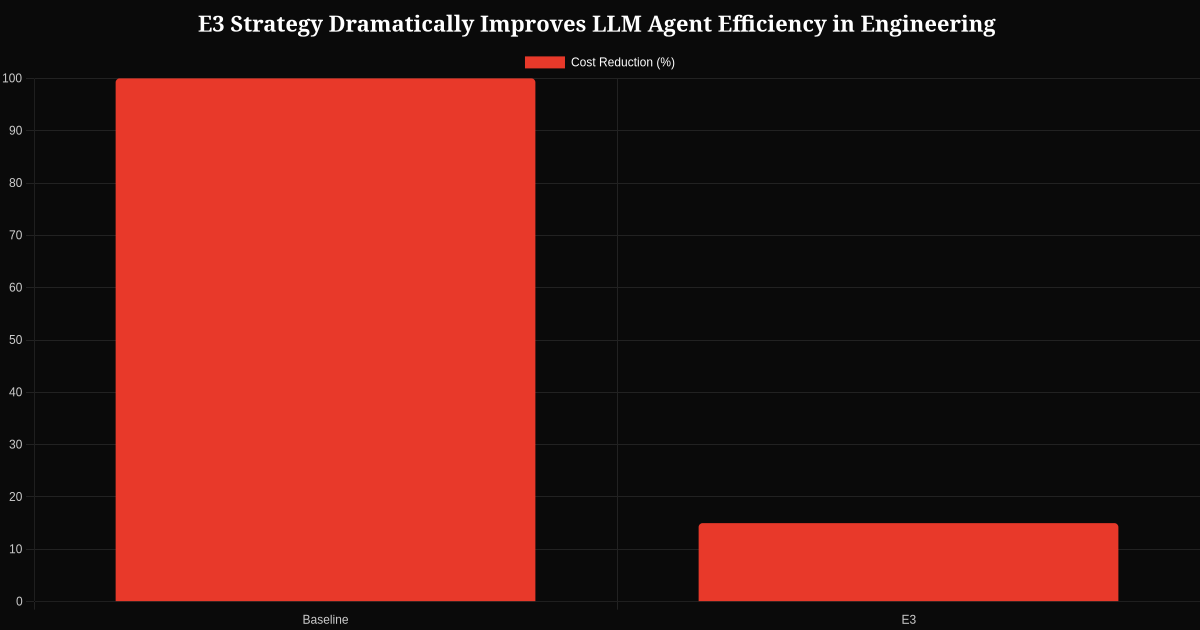
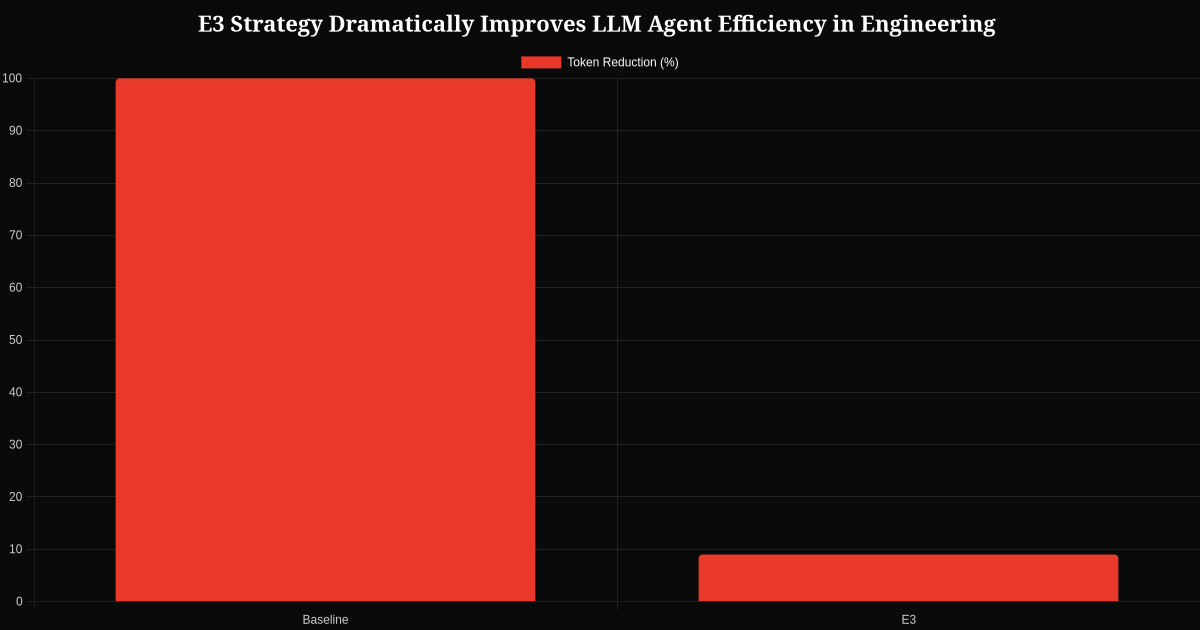
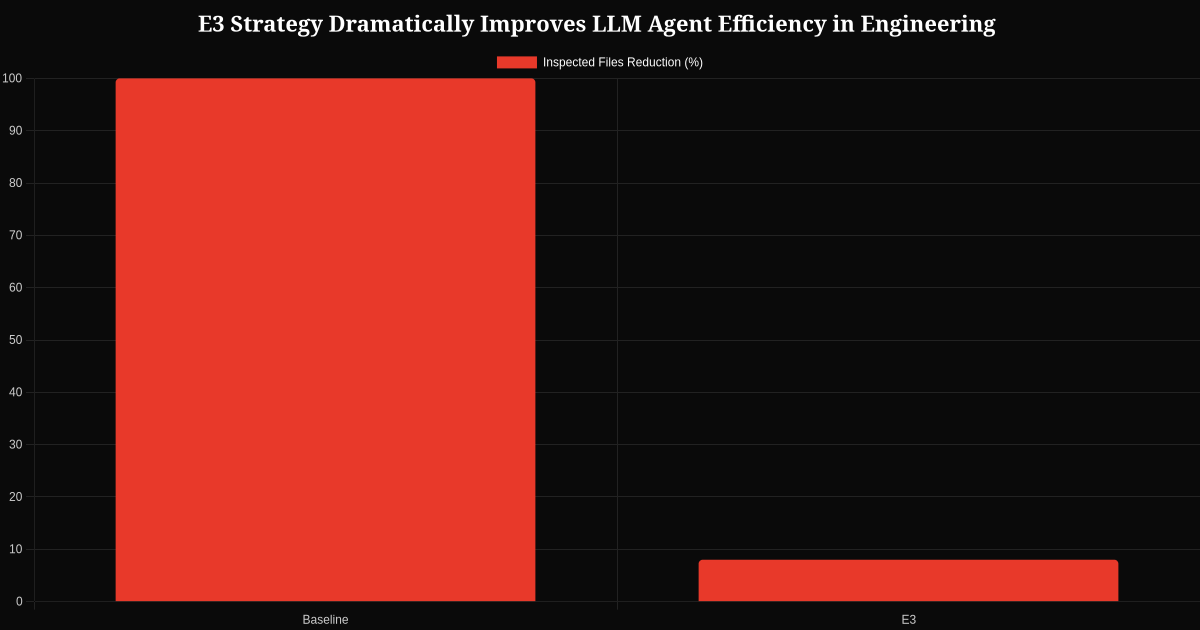
On MSE-Bench, a deterministic benchmark comprising 121 code edits within a capability-controlled simulator, E3 demonstrated significant improvements. It successfully matched the strongest baseline's 100% task success rate while simultaneously achieving substantial resource reductions:
- Cost Reduction: E3 cut operational costs by 85% compared to the baseline.
- Token Reduction: The strategy reduced token consumption by 91%.
- Inspected Files Reduction: E3 decreased the number of inspected files by 92%.
Furthermore, E3 outperformed a strong adaptive retrieval baseline by 16% on this benchmark. The observed gains in efficiency were robust, persisting across variations in instruction wording and different cost weighting schemes, indicating the method's generalizability.
A companion real-model harness, LLM-Case, corroborated these findings using a live GPT-4o agent tasked with editing a real open-source library. Candidate patches were graded by executing the project's actual pytest suite against a measured oracle. While the degree of over-reading was milder in this real-world scenario, it was still present. E3 emerged as the leanest and fastest policy, achieving comparable task success rates. The only identified shortfall was a provider rate-limit, not an incorrect edit, further underscoring E3's operational efficiency.
Developer Implications
For developers working with or building LLM agents, the E3 strategy offers direct and substantial benefits. The most immediate impact is a drastic reduction in operational costs associated with API calls, as agents consume significantly fewer tokens and perform less redundant context processing. This translates into more cost-effective deployment and scaling of agent-driven solutions.
Beyond cost, E3 leads to faster task execution. By minimizing unnecessary steps and information retrieval, agents can reach solutions more quickly, improving the overall responsiveness and throughput of automated workflows. This is particularly critical in multi-step engineering tasks like code generation, refactoring, or debugging, where iterative processes can quickly accumulate overhead.
The availability of the E3 framework and its accompanying benchmark provides a practical toolkit for developers. It enables them to implement complexity-aware reasoning in their own agent designs or to evaluate existing agents against a quantifiable measure of execution redundancy. This moves the field closer to building truly "engineering-grounded AI"—agents that are not only capable but also inherently efficient and resource-aware, aligning their computational effort with the actual demands of the task at hand.
Bottom Line
The E3 (Estimate, Execute, Expand) strategy represents a significant advancement in the efficiency and operational intelligence of LLM agents. By directly addressing the pervasive problem of over-reading and redundant processing, E3 enables agents to perform multi-step engineering and informatics tasks with unprecedented resource efficiency. The demonstrated 85% cost reduction and over 90% savings in tokens and inspected files on benchmarks like MSE-Bench highlight its potential to transform how developers deploy and manage AI agents. E3 is a crucial step towards creating more economical, faster, and truly engineering-grounded AI systems, making advanced automation more practical and scalable for real-world applications.
Pneumetron
Data Insights
PNEUMETRON EDITORIAL TEAM
Rajini Ravindra holds an M.A. in History from Mysore University (KSOU). Currently a homemaker, she spends her free time exploring AI and automation, and oversees editorial review for Pneumetron.
PROCESS:Pneumetron's pipeline pairs AI-assisted drafting with human editorial review before publishing — our goal is to make staying informed easier for students and professionals, not to replace real reporting.
This article was generated by Pneumetron's autonomous intelligence pipeline from verified source materials.
Open Source Document at arxiv ↗