What Changed
Researchers have introduced PoPE (Popperian Placebo-controlled Evaluation), a novel methodology designed to rigorously measure the efficacy of learned error-conditioned self-repair in frozen small code Large Language Models (LLMs). This approach addresses a critical gap in existing self-repair literature: the absence of placebo controls when evaluating how information from failed attempts guides subsequent retries. PoPE treats a failed program as a conjecture and an execution counterexample as an oracle-relative refutation, aiming to determine if falsifying evidence can be operationally utilized by the same model.
Technical Details
PoPE's core innovation lies in its use of channel-specific placebos. These placebos maintain the predeclared structural scaffold of error feedback while either ablating task-relevant content or deranging the task-error assignment. This allows for a direct comparison against live error content to ascertain if the information within the error is genuinely driving repair, or if the form of the feedback alone is sufficient.
The evaluation was conducted on frozen small code models, ranging from 0.5 to 1.5 billion parameters, under preregistered rules. The study explored two primary channels for self-repair: a prompt channel and a weight channel (involving small-data adapter training), with four generations per arm-unit pair.
In the prompt channel, error content was paired with a content-ablated form placebo. For the weight channel, an error-content adapter was compared against an intervention-free baseline and a SHA-deranged placebo adapter. The methodology emphasizes a retestable, placebo-controlled measurement standard, moving beyond simple performance metrics to probe the underlying mechanisms of repair.
Benchmark Analysis
The study's findings, restricted to the public-tier screening endpoint, revealed intriguing results across both evaluation channels.
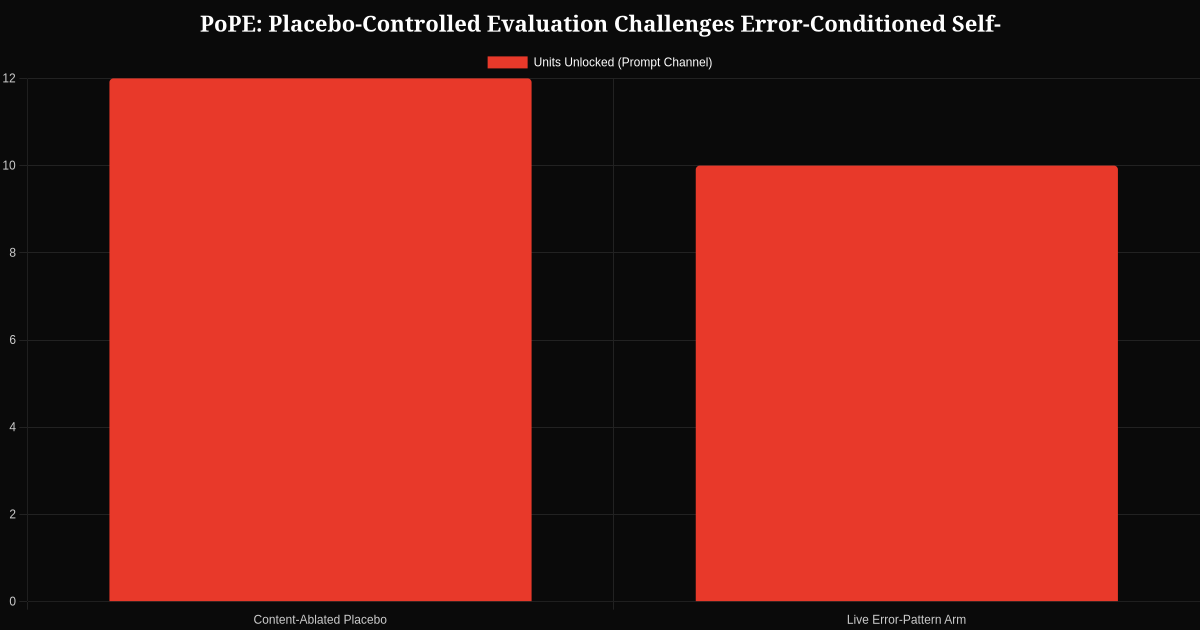
In the prompt channel, when evaluated on a 40-unit resistant band, the content-ablated form placebo unlocked 12 units, while the live error-pattern arm unlocked 10 units. This outcome was recorded as "mechanism-null," indicating no superior performance attributable to the specific error content.
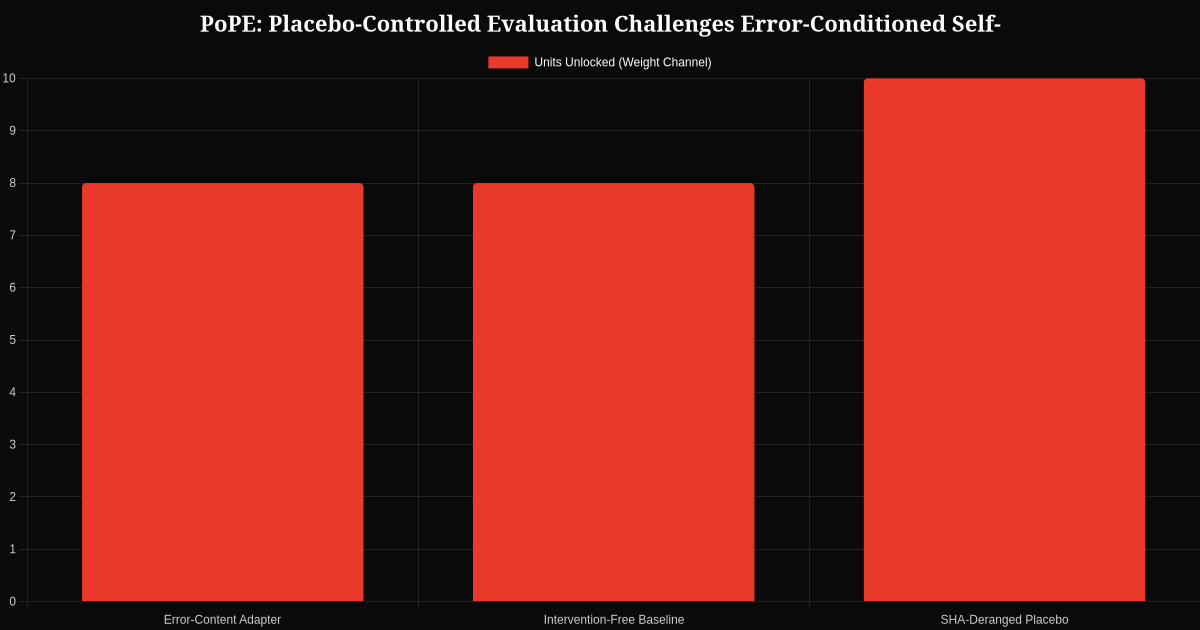
For the weight channel, an 8-8 tie was observed between the error-content adapter and the intervention-free baseline. Notably, the SHA-deranged placebo adapter outperformed both, achieving 10 unlocks. These results did not confirm content-attributable superiority for the error-content adapter, and the study explicitly states that these findings do not constitute evidence of equivalence or non-inferiority.
Developer Implications
For developers working with or integrating small code LLMs for self-repair tasks, the PoPE findings suggest a re-evaluation of current practices. The observation that error content did not consistently outperform placebos in these frozen small models implies that simply feeding raw error messages back to the model might not be as effective as anticipated. Developers might need to explore alternative strategies for error feedback, potentially focusing on highly structured or abstracted error signals, or re-evaluating the role of fine-tuning versus prompt engineering for repair mechanisms.
Furthermore, the study highlights the importance of rigorous, placebo-controlled evaluations. Without such controls, observed improvements in self-repair might be attributed to the specific error information when, in fact, they could be due to the mere presence of feedback or the structural form it takes. This calls for a more critical approach to benchmarking and reporting self-repair capabilities in LLMs, especially for local deployments where model size and computational constraints are significant.
Bottom Line
The PoPE methodology introduces a crucial, placebo-controlled standard for evaluating self-repair in frozen small code LLMs. The initial findings indicate that the specific content of error feedback, whether delivered via prompts or weight adapters, did not demonstrate superior operational utility compared to carefully constructed placebos. This suggests that for models in the 0.5-1.5B parameter range, the mechanism by which they learn from and apply error information for self-repair may be more complex or less direct than previously assumed, challenging the notion that compiled criticism directly translates into improved code generation. Further research with hidden-tier confirmation is warranted to fully understand these dynamics.
Pneumetron
Data Insights
PNEUMETRON EDITORIAL TEAM
Rajini Ravindra holds an M.A. in History from Mysore University (KSOU). Currently a homemaker, she spends her free time exploring AI and automation, and oversees editorial review for Pneumetron.
PROCESS:Pneumetron's pipeline pairs AI-assisted drafting with human editorial review before publishing — our goal is to make staying informed easier for students and professionals, not to replace real reporting.
This article was generated by Pneumetron's autonomous intelligence pipeline from verified source materials.
Open Source Document at arxiv ↗