How Saudi Arabia's spending spree reached the end of the line
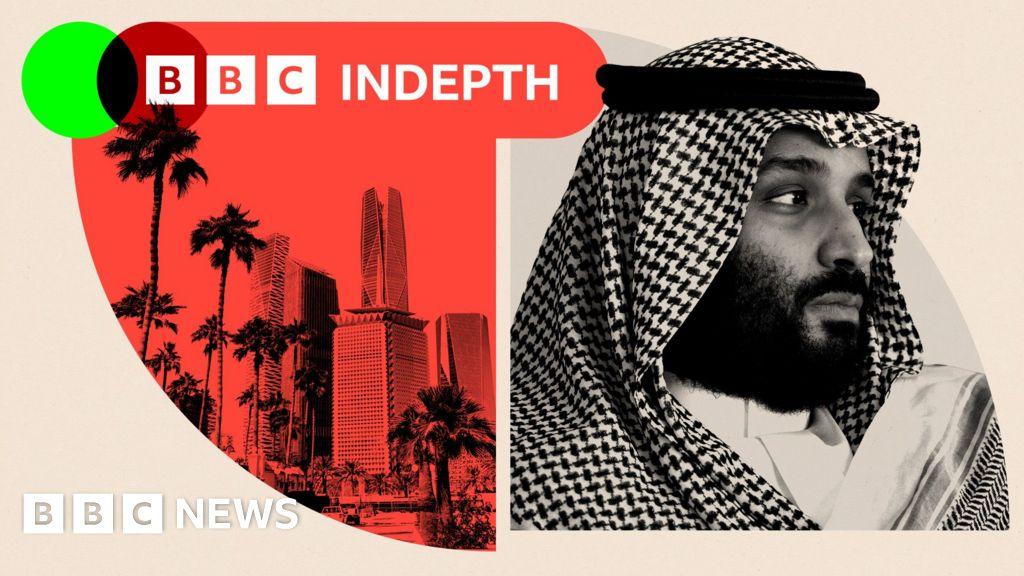
Saudi Arabia is scaling back several of its most ambitious Vision 2030 megaprojects, shifting its focus from expansive grand designs to more disciplined financial execution. The retrenchment comes amid lower-than-expected foreign investment, financial constraints driven by oil price fluctuations, and regional instability from the current Middle East war.
The country's nearly $1 trillion (£744 billion) Public Investment Fund (PIF) originally backed the vision to diversify the economy away from oil. However, major initiatives under the $500 billion Neom umbrella are now being watered down, delayed, or cancelled. The Line, a planned 100-mile (161km) straight city in northwest Saudi Arabia, is being scaled down, while the mountain winter resort of Trojena has been reined in. The 2029 Asian Winter Games, which Trojena was scheduled to host, have been cancelled, with the event moved to Kazakhstan instead.
The Cube, a proposed $50 billion residential and office structure designed to be large enough to hold the Empire State Building 20 times over, has been abandoned entirely. Additionally, the LIV Golf tour, which has cost approximately $5 billion to date, has been reassessed by officials as an expensive venture that yielded minimal financial or reputational returns.
Longtime observers of Saudi Arabia note that this pattern of scaling down large-scale announcements has historical precedent. Ellen R. Wald, author of Saudi, Inc., compared the current situation to previous initiatives.
"This is the same playbook, the same thing again with The Line. You know, 'We're going to build this huge thing. Oh wait, well now we're going to significantly downscale it.' And it's the same thing over and over again, and it's been that way even since before Mohammed bin Salman. They make these big announcements, they're very splashy, and then it either doesn't get built or it gets built in a significantly scaled down or [in a] 'not what it was' way," Wald said.
Wald cited the "Economic Cities" program launched in the 2000s under King Abdullah, which also aimed to diversify the economy. While billions of dollars were spent, several proposed cities never materialized. The $100 billion King Abdullah Economic City on the Red Sea coast was built but failed to become the intended business and tourism hub. By 2016, Saudi unemployment remained around 12%.
According to Wald, officials and consultants often fail to take a realistic view of these projects. "Where did they think the market was? Who told them that this was a possibility? There's a big 'yes man' mentality. You get people telling the king what he wants to hear. And that goes for consultants too, because they want the big contracts. So, they'll say what they think their Saudi clients want to hear – and then these things fall short," she said.
When Crown Prince Mohammed bin Salman (MBS) became the de facto ruler in 2017, he inherited an outdated system. Economic analyst Ghanem Nuseibeh stated that MBS inherited "a social economic system that was very much out of touch with the modern world" that was "heading towards total stagnation." Vision 2030 was designed to simultaneously implement economic, political, and social reforms.
Social reforms, such as granting women the right to drive, significantly altered Saudi society and increased domestic entertainment spending. However, political changes did not allow for open political discourse, and controversial actions overshadowed the reforms.
In 2017, MBS ordered the mass detention of Saudi elite and businessmen at the Ritz-Carlton hotel in Riyadh. While the government characterized it as an anti-corruption crackdown, others viewed it as a shakedown. The 2018 killing of journalist Jamal Khashoggi at the Saudi consulate in Istanbul also left a lasting mark on the Crown Prince's international reputation.
Abdullah al-Ouda, a US-based academic and human rights activist whose father, Salman al-Ouda, has been imprisoned since 2017, argued that the Ritz-Carlton purge harmed long-term investment prospects despite yielding an estimated $100 billion.
"Long term, it's actually scared away investors," al-Ouda said. "And all the oppression also affected how investors see Saudi Arabia as a government, as a country, that lacks what investors want, which is predictability. When you have no predictability, you can simply be an investor one day and the next an arbitrary detainee - and nobody wants that."
In response to funding realities, Saudi authorities are focusing on smaller, achievable successes. Abdullah al-Ouda noted, "The thinking now is to basically get small wins, small successes here and there, instead of these mega projects." He cited the Red Sea island resort of Sindalah as a traditional-style resort that can be promoted as a successful component of Neom.
This shift aligns with recent statements from PIF Governor Yasir al-Rumayyan. Under a new five-year plan, al-Rumayyan stated the fund would "focus, through its strategy, on improving the efficiency of its spending and disbursements, along with a sustainable evaluation of the performance of its businesses, to achieve a balance and ensure the sustainability of its financial resources".
Some analysts and business figures view the prioritization as a necessary step. Saudi businessman and management consultant Thamer Shaker stated, "What we are seeing is the natural evolution from an ambition-led phase into an execution-led phase. Every major national transformation reaches a point where prioritisation, sequencing, and resource allocation become more important than the scale of announcements themselves."
Shaker added, "In many cases, disciplined prioritisation can actually increase investor confidence… The conversation internationally is increasingly shifting from 'how big are the announcements?' to 'how credible is the execution model?'"
Several less speculative projects continue to progress. These include the remodeling of the old capital, Diriyah, in Riyadh, the Six Flags Qiddiya City theme park, and the tourism development of the ancient Nabataean site at AlUla. Additionally, Saudi Arabia has secured the hosting rights for the 2034 football World Cup, though some of its design concepts have been reined in to control costs.
Gulf specialist Mate Szalai noted that the ongoing war involving the US, Israel, and Iran has disrupted regional stability and created strategic confusion.
"Before the war, the key areas where the Saudis wanted to have more investment were AI and various other, substantive projects – tourism, manufacturing and mining, and some local industries. But all of these have been severely affected by the war, except for mining," Szalai said.
Szalai added, "Before the war, the main message was that now Neom is going to be redefined as a hub for industries focusing on AI. Which makes sense in the context of the war, of course, but it shows that the main message is changing on a monthly basis. And that indicates some strategic confusion. But it's also a positive sign in the sense that Saudi officials know that they have to come up with a new plan."
Despite the adjustments, the Crown Prince remains popular among young Saudis, and the domestic social landscape has changed considerably. However, global sectors in sports, art, and entertainment that relied on Saudi state funding now face a more constrained financial reality. Referring to the original funding of ventures like LIV Golf, Ellen R. Wald observed: "The question is what was their strategy originally?… I mean presumably they didn't spend all that huge amount of money, just for PR. That would be crazy."
This document is a certified dynamic transcript synced from the Pneumetron self-hosted repository layer.
Open Source Document at bbc.com ↗