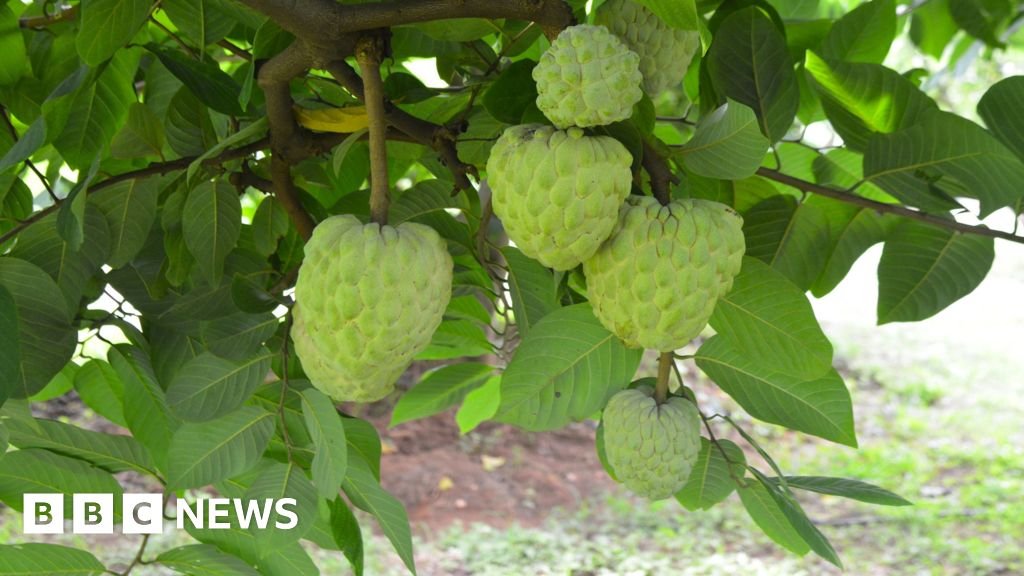
The custard apple is experiencing a rise in demand both within India and internationally, emerging as a viable crop for farmers in drought-prone regions. The fruit, known for its creamy texture and sweet flavor, is increasingly being grown using advanced hybrid varieties that address historical challenges such as short shelf life and low pulp yield.
In the drought-prone district of Kolar in southern India, farmer Ashoka Shivareddy revived his family's farm in 2018 using a scientific approach after they had abandoned farming in 2005. "The area receives rainfall of only 60 to 70 centimetres, and farmers dig borewells of up to 1,300 feet - most of their money goes into chasing water," Shivareddy says. Looking for a hardy crop, he chose the custard apple, planting trees close together and selecting three specific varieties to maximize yield. "I was looking for a crop that could survive with very little water, grow with rainfall, and not depend heavily on pesticides," he explains. Shivareddy produced approximately 20 tonnes last year and 25 tonnes this year, noting that "there is huge demand for custard apple in India and abroad."
Despite the crop's resilience, cultivation faces distinct challenges. The traditional Balangar variety has a shelf life of only three to four days and contains numerous seeds. Additionally, custard apple seeds are toxic when crushed, and the European Food Safety Authority has raised questions regarding the safety of food supplements derived from the fruit. "Traditional varieties have excellent flavour, but they suffer from low pulp content, high seed count, and a very poor shelf life," says Dr Sakthivel T, principal scientist at the Indian Institute of Horticulture Research (IIHR) in Bangalore.
To address these issues, Dr Sakthivel's team developed Arka Sahan, a hybrid variety with fewer seeds, a week-long shelf life at room temperature, and a 70% pulp recovery rate compared to 30% in wild varieties. "The shift from 30% pulp recovery in wild varieties to 70% recovery in hybrids like Arka Sahan has effectively doubled the usable harvest for farmers without needing more land," Sakthivel says. The IIHR is also researching techniques to prevent extracted pulp from turning brown, experimenting with new equipment to help the pulp maintain its milky color for longer.
Maharashtra is India's leading producer of custard apples, representing nearly a third of national output. In this state, farmer Navnath Malhari Kaspate spent decades cross-pollinating seeds to develop the high-yielding NMK-01 variety, which went on sale in 2014. "No one had really paid attention to custard apple or done research, so I decided to keep working on it. It takes 12 to 15 years to develop a new variety. This is not quick work - it's decades of experimentation," Kaspate says. Today, Kaspate cultivates the fruit on nearly 50 acres, yielding about 10 tonnes per acre. "We now grow custard apple on nearly 50 acres, with yields of about 10 tonnes per acre. This improved variety which does not get spoiled has created opportunity for exports. We started exporting to Gulf countries, and even sent it to Europe, something that hadn't been done before at this scale," Kaspate says.
Manoj Kumar Barai, who exports the NMK-01 variety to the US, UAE, Saudi Arabia, and Europe, prefers it for its thicker skin, better shelf life, and higher pulp content. However, exporting the delicate fruit requires precise coordination. "We have to plan everything precisely - harvesting time, transport to pack houses, airport transfer, flights, customs clearance - every hour matters," Barai says. The fruit is highly sensitive to heat, meaning transit must be carefully managed. "Custard apple is highly sensitive to heat, and even short exposure can reduce its shelf life," Barai explains. "In regions like Maharashtra, temperatures can go up to 40 degrees, and even during transit it can reach 30–35 degrees, which is not ideal for this fruit." To mitigate this, transporters often travel overnight, pre-cool the fruit for five hours, and utilize specialized corrugated cooling boxes and refrigerated vans.
Exporting custard apple as frozen pulp or powder at -18C has emerged as a more cost-effective alternative to shipping fresh whole fruit, preventing waste during transit. In Kolar, Shivareddy plans to establish a pulp processing unit to utilize unsold portions of his harvest. However, the investment required to chill pulp to -20C remains a barrier for many. Shivareddy notes that the crop's natural resilience has slowed technological adoption among local farmers: "Custard apple sits in a strange gap. Demand is rising, but the farming hasn't gone high-tech as the crop is naturally hardy. It grows in poor soil, needs very little water, and survives on rainfall. Farmers don't need expensive irrigation, sensors, or controlled environments so tech adoption stays low."
Pneumetron
PNEUMETRON EDITORIAL TEAM
Rajini Ravindra holds an M.A. in History from Mysore University (KSOU). Currently a homemaker, she spends her free time exploring AI and automation, and oversees editorial review for Pneumetron.
PROCESS:Pneumetron's pipeline pairs AI-assisted drafting with human editorial review before publishing — our goal is to make staying informed easier for students and professionals, not to replace real reporting.
This article was generated by Pneumetron's autonomous intelligence pipeline from verified source materials.
Open Source Document at bbc.com ↗