What Happened
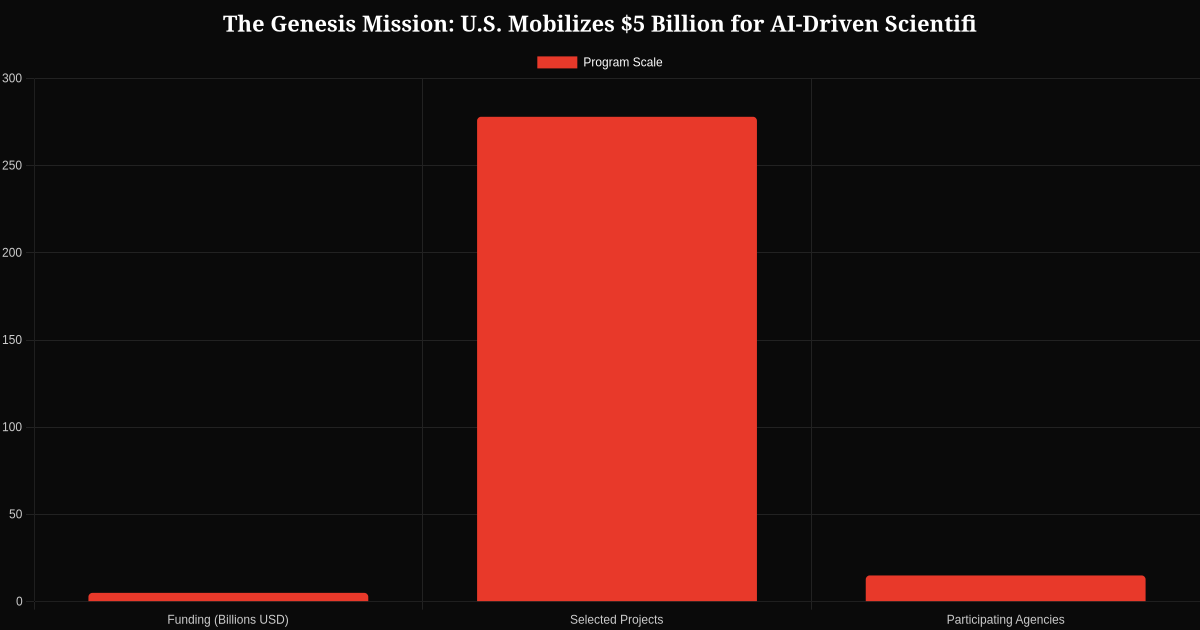
In a significant move to reshape the landscape of American scientific inquiry, the federal government has officially launched the Genesis Mission, a national initiative backed by more than $5 billion in funding. Initiated by a Presidential Executive Order in November 2025, the mission serves as a centralized effort to harness the power of artificial intelligence to solve complex scientific challenges. The program, which has rapidly evolved into a whole-of-government undertaking, now involves over 15 federal agencies contributing research funding, specialized datasets, and critical infrastructure. The formal rollout of the mission, including the announcement of 278 selected research projects, was highlighted during the Genesis Mission 2026 Summit held in July 2026. This mobilization represents one of the largest coordinated efforts in recent history to apply advanced computational tools to the foundational problems of science, spanning fields from medicine and energy to infrastructure and national defense.
Key Details
The cornerstone of the Genesis Mission is the American Science and Security Platform, a shared infrastructure developed by the Department of Energy (DOE). Historically, federal scientific research has been characterized by fragmented investments and isolated data silos, where individual departments operated within their own technical boundaries. The new platform is designed to dismantle these barriers by providing researchers with centralized access to high-performance computing, specialized AI tools, and vast, cross-disciplinary datasets.
More than 15 federal agencies are now participating in the initiative, each contributing unique resources. For instance, the Department of Health and Human Services (HHS) is utilizing the platform to integrate national health cohorts with environmental data from the Environmental Protection Agency and biological research from the National Science Foundation. This integration is specifically targeting the root causes of chronic diseases and pediatric cancer. Similarly, the Department of Transportation is collaborating with the DOE to develop digital twins—virtual replicas of physical systems—to simulate infrastructure performance and improve maintenance strategies. The Department of Defense is also a major participant, scaling investments in AI, quantum computing, and biotechnology to transform long-term data into actionable insights for national security. The 278 projects selected for funding represent the first wave of this collaborative strategy, chosen for their potential to deliver tangible societal and technological benefits.
Context
The Genesis Mission is framed by its architects as the next chapter in a long tradition of American national mobilizations, comparable to the investments that established the foundations of the modern internet. Michael Kratsios, Director of the White House Office of Science and Technology Policy, has emphasized that the mission is intended to foster scientific discovery at a scale that remains unmatched globally.
Before the implementation of this mission, federal research was often hampered by logistical challenges that prevented true interagency collaboration. While individual departments pursued high-impact research, the lack of a unified computational framework meant that data could not be easily shared or analyzed across departmental lines. The Genesis Mission addresses this by creating a standardized, secure environment where researchers can leverage the DOE’s supercomputing power. This shift is not merely a change in funding levels; it is a fundamental change in the methodology of scientific research, moving from isolated, project-based inquiry to a networked, platform-based approach that prioritizes rapid data analysis and clinical translation.
Why It Matters
The implications of the Genesis Mission are far-reaching, particularly in the realm of medical discovery and infrastructure resilience. By linking molecular, genomic, and clinical datasets, the mission aims to accelerate the development of targeted therapies for rare conditions and chronic diseases that have historically been difficult to treat. The urgency of this work is underscored by leadership at the National Institutes of Health, who have noted that patients cannot afford to wait decades for scientific breakthroughs to reach the clinic.
Beyond healthcare, the mission’s focus on digital twins and AI-driven simulations for infrastructure is expected to produce more resilient, cost-effective, and sustainable transportation networks and power grids. By optimizing grid behavior and structural simulations, the government aims to enhance the reliability of essential services for American families and businesses. Furthermore, the Department of Defense’s involvement signals that the mission is also a strategic effort to maintain technological dominance. By converging AI, quantum computing, and biotechnology, the U.S. seeks to secure a distinct advantage in fields that will define the future of both national defense and global economic competitiveness. The collaborative nature of these projects ensures that the benefits of AI are not limited to a single sector but are distributed across the entire national economy.
Bottom Line
The Genesis Mission represents a deliberate and ambitious pivot toward a centralized, AI-powered model of scientific research. By committing $5 billion and unifying the efforts of over 15 federal agencies, the U.S. government is attempting to eliminate the inefficiencies of the past and create a more agile, data-driven framework for discovery. Whether this initiative succeeds in its goals of revolutionizing healthcare, infrastructure, and national security will depend on the sustained integration of these diverse agencies and the continued effectiveness of the American Science and Security Platform. As the 278 initial projects begin their work, the mission stands as a testament to the belief that the next generation of scientific breakthroughs will be driven by the convergence of artificial intelligence and large-scale, coordinated federal investment.
Pneumetron
Data Insights
PNEUMETRON EDITORIAL TEAM
Rajini Ravindra holds an M.A. in History from Mysore University (KSOU). Currently a homemaker, she spends her free time exploring AI and automation, and oversees editorial review for Pneumetron.
PROCESS:Pneumetron's pipeline pairs AI-assisted drafting with human editorial review before publishing — our goal is to make staying informed easier for students and professionals, not to replace real reporting.
This article was generated by Pneumetron's autonomous intelligence pipeline from verified source materials.
Open Source Document at news_rss ↗