Anthropic has released upgraded versions of its most capable models, Claude Fable 5.2 and Claude Mythos 5.2, alongside a wave of concurrent research that pushes the boundaries of open-source fleets, embodied AI, and domain-specific evaluation. The model upgrades deliver faster inference, reduced pricing, and significant gains on agentic coding and scientific reasoning benchmarks. Simultaneously, researchers have demonstrated that scaling vision-language models to 552 billion parameters substantially improves robot sample efficiency and generalization. In the open-source space, a new fleet of six models ranging from 0.9 billion to 375 billion parameters has been released with complete training transparency. Finally, a new benchmark for German public law reveals the actual impact of retrieval-augmented generation on complex legal reasoning.
Anthropic Upgrades Fable and Mythos 5.2
Anthropic released Claude Fable 5.2 and Claude Mythos 5.2 on November 9, 2026. The two models share an identical underlying architecture, with Fable featuring robust cybersecurity and biology safeguards for general access, while Mythos provides enhanced capabilities for organizations pursuing beneficial applications in those fields through verification programs. The update focuses on improving coding, reasoning, and vision capabilities, alongside operational efficiency.
The models generate outputs up to 30% faster than their 5.1 predecessors. Pricing has been adjusted downward to $8 per million input tokens and $40 per million output tokens. An optional fast mode is available for $16 and $80 per million tokens respectively, accelerating generation by up to 2.5 times. Anthropic reports that over 90% of changes merged into its core codebase are now written by Claude, with human guidance.
Benchmark evaluations position Fable 5.2 and Mythos 5.2 above Anthropic’s Opus 5.5 and competing frontier models in several technical categories. On the FrontierCode 2.0 benchmark, Fable 5.2 achieved a score of 49.1%, outperforming Opus 5.5 at 45.5% and GPT-6 Astra at 42.8%. In agentic software engineering tasks measured by FrontierSWE v2, Fable 5.2 reached 69.9%, compared to 62.3% for Opus 5.5 and 65.5% for GPT-6 Astra. Mythos 5.2 demonstrated specialized strength in cybersecurity, scoring 76.3% on CyScenarioBench and 89.6% on CVE Rediscovery, surpassing Opus 5.5’s 67.6% and 81.3% respectively.
| Model | FrontierCode 2.0 | FrontierSWE v2 | CyScenarioBench | RoboDojo Sim |
|---|---|---|---|---|
| Fable 5.2 | 49.1% | 69.9% | — | 64.9% |
| Mythos 5.2 | — | — | 76.3% | — |
| Opus 5.5 | 45.5% | 62.3% | 67.6% | 39.4% |
| GPT-6 Astra | 42.8% | 65.5% | — | — |
Anthropic highlighted several autonomous engineering and scientific applications. A team of agents using an earlier Fable 5.2 version migrated a critical production service from Python to Rust, resulting in a service that starts approximately 26 times faster. In a separate experiment, a single engineer tasked Fable 5.2 with designing a prototype operating system; the model coordinated over 1,000 subagents over eight days to produce a bootable OS with drivers, file storage, and a login screen. The models also solved two open problems in theoretical physics regarding black hole transitions and quantum gravity limits, and fully formalized Fermat’s Last Theorem in 30 hours using a 1,000-agent setup, requiring one-third the action tokens of previous attempts.
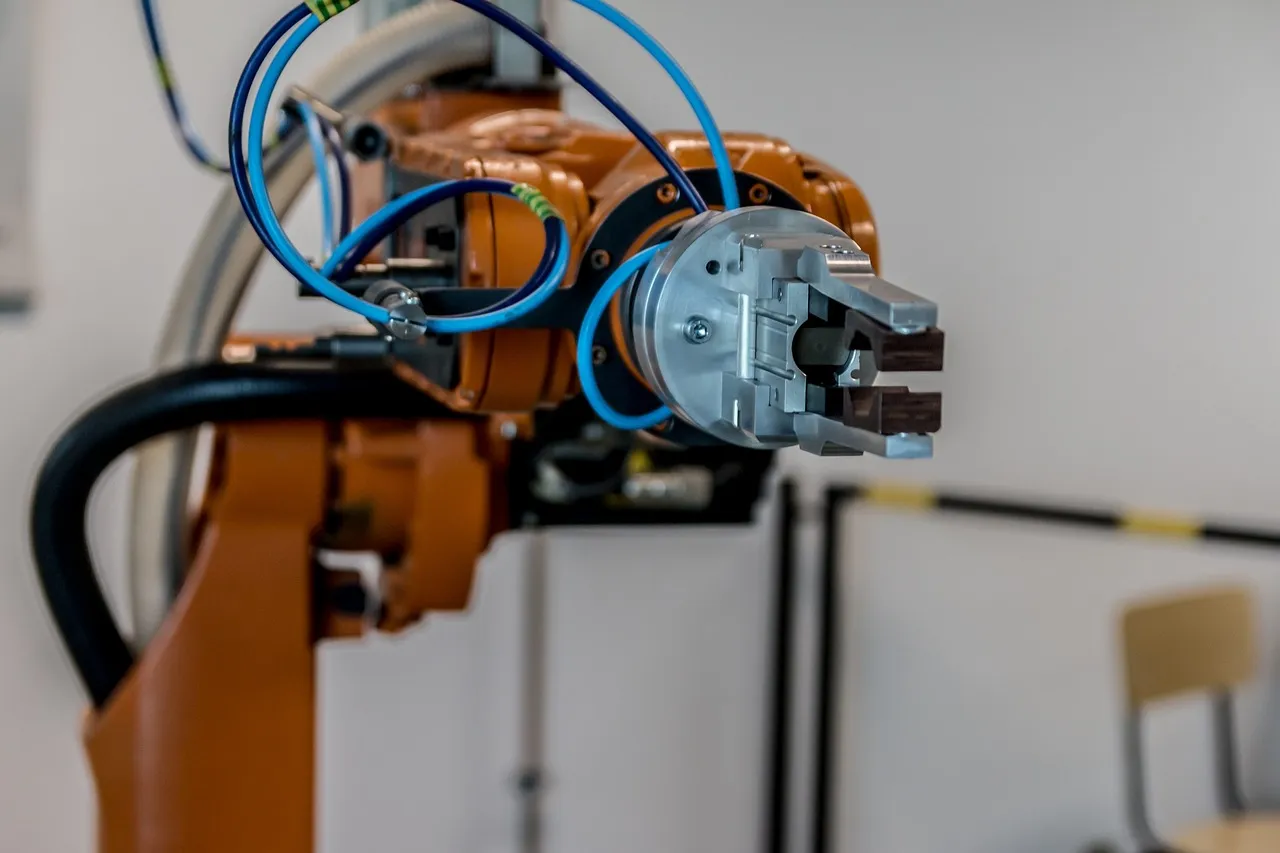 Illustrative image: jarmoluk / Pixabay
Hardware and robotics capabilities also advanced. Collaborating with circuit board manufacturer Diode, Fable 5.2 designed three working electronic devices, including a voice-assistant hub and a USB speakerphone, routing four-layer circuit boards and programming software with minimal human input. On the RoboDojo Sim benchmark, Fable 5.2 achieved a score of 64.9%, significantly outperforming Opus 5.5 at 39.4% and demonstrating improved control over physical robots for tasks like solving puzzle cubes and unscrewing bottle caps.
Scaling Vision-Language-Action Models to 552B
A separate research effort published on November 16, 2026, investigates whether frontier-scale vision-language models can serve as stronger foundations for robot learning. The paper introduces ScaleVLA, which connects a 552 billion parameter DeepSeek-V4.1-Flash backbone to a trainable diffusion transformer (DiT) action head. The study systematically compares VLM backbones ranging from 2 billion to 552 billion parameters under a fixed training setup.
The researchers evaluated three fundamental capabilities: sample efficiency, generalization, and precise manipulation. Key findings include:
- In sample efficiency tests on the LIBERO-Goal benchmark, ScaleVLA achieved a 87.8% success rate with only 10 demonstrations per task, surpassing a 2 billion parameter backbone trained with 50 demonstrations (85.6%).
- For generalization, ScaleVLA reached a 45.1% average success rate on the perturbed LIBERO-PRO benchmark, compared to a maximum of 31.3% for smaller dense backbones.
- Real-world manipulation trials on a bimanual robot charger-insertion task showed ScaleVLA succeeding in 9 out of 10 reference-layout trials, compared to 4 out of 10 for the 2 billion parameter baseline.
Despite the massive model size, ScaleVLA achieved a median inference latency of 216 milliseconds per action chunk using four NVIDIA H200 GPUs. The architecture extracts features from the causal encoder of the VLM without running the decoder, allowing the action head to map representations directly to continuous robot actions.
K2-Horizon Releases a Fully Open Frontier Fleet
Researchers from the Institute of Foundation Models released K2-Horizon, a fleet of six fully open language models ranging from a 0.9 billion parameter dense model to a 375 billion parameter mixture-of-experts (MoE) model that activates 23 billion parameters per token. The release adheres to the LLM360 definition of open source, providing final weights, intermediate checkpoints from every training stage, pre-training data, training logs, and all pipeline code.
 Illustrative image: Pexels / Pixabay
The fleet includes the following models:
- Dense models at 0.9B, 3.7B, 7B, and 32B.
- MoE variants at 36B-A4B and 375B-A23B.
The 36B-A4B model introduces Mixture-of-Value Attention (MoVA) and softplus attention gating, allowing it to match the performance of the 32B dense model while using only one-seventh of the active parameters. The 375B-A23B flagship was trained on a 22 trillion token corpus, with approximately 10 trillion tokens being synthetic. Post-training involved training separate reinforcement learning experts for domains like search, tool use, and scientific reasoning, which were then merged via weight merging and refined with supervised fine-tuning.
In agentic and coding evaluations, the 375B-A23B model ranked first or second among comparable open-weight models. It led on Toolathlon-Verified with a score of 65.3, surpassing GPT-5.6 Terra, and achieved 48.4 on SWE-Atlas-QnA for repository-level code understanding. The smaller 7B model outperformed similarly sized open-weight models on most benchmarks and led SWE-bench Verified by wide margins. The release enables controlled studies of scale and sparsity, as four models were trained on identical data batches with hyperparameters scaled together.
GPBam Benchmarks German Legal Reasoning and Retrieval
A recent paper introduces GPBam, a benchmark designed to evaluate legal reasoning in civil-law systems, specifically focusing on German public law. Unlike common-law benchmarks that often rely on classification or short-answer formats, GPBam requires models to write complete structured legal opinions (Gutachten) for 81 state-exam-style cases. The reference solutions average 7,080 words, creating a long-form generation task that tests issue spotting, statutory recall, and subsumption.
The benchmark jointly scores statute retrieval and essay quality. Researchers evaluated 32 open-weight and proprietary models without retrieval, finding scores spanning 4.81 to 76.42 out of 100. When statutes were supplied via retrieval systems, performance gains were limited. Across seven models and eight retrieval configurations, gold-norm recall improved nearly threefold, but the largest non-oracle improvement over no retrieval was only 4.1 essay score points. Three of the seven generators showed no significant improvement from retrieval.
An oracle condition that supplied the exact statutes cited by the reference solution achieved 91.31% recall and raised essay scores by 2 to 6 points across all tested models. The study found that closed-book statutory recall correlated strongly with essay quality (rho=0.92), suggesting that the primary bottleneck for legal reasoning in this setting is parametric knowledge of the law rather than retrieval failure. The benchmark highlights the challenges of retrieval-augmented generation in complex, document-level legal argumentation.
Sources
- anthropic.com: Introducing Claude Fable 5.2 and Claude Mythos 5.2
- arXiv: GPBam: A Retrieval-Aware German Public Law Exam BenchmarkThanks: This paper is an extended version of a paper
- arXiv: ScaleVLA: Scaling Vision-Language-Action Models to 552 Billion Parameters
- arXiv: K2-Horizon: A Frontier Fleet of Open Source Language Models
Pneumetron
PNEUMETRON EDITORIAL TEAM
Rajini Ravindra holds an M.A. in History from Mysore University (KSOU). Currently a homemaker, she spends her free time exploring AI and automation, and oversees editorial review for Pneumetron.
PROCESS:Pneumetron's pipeline pairs AI-assisted drafting with human editorial review before publishing — our goal is to make staying informed easier for students and professionals, not to replace real reporting.
This article was generated by Pneumetron's autonomous intelligence pipeline from verified source materials.
Open Source Document at anthropic.com, arXiv ↗