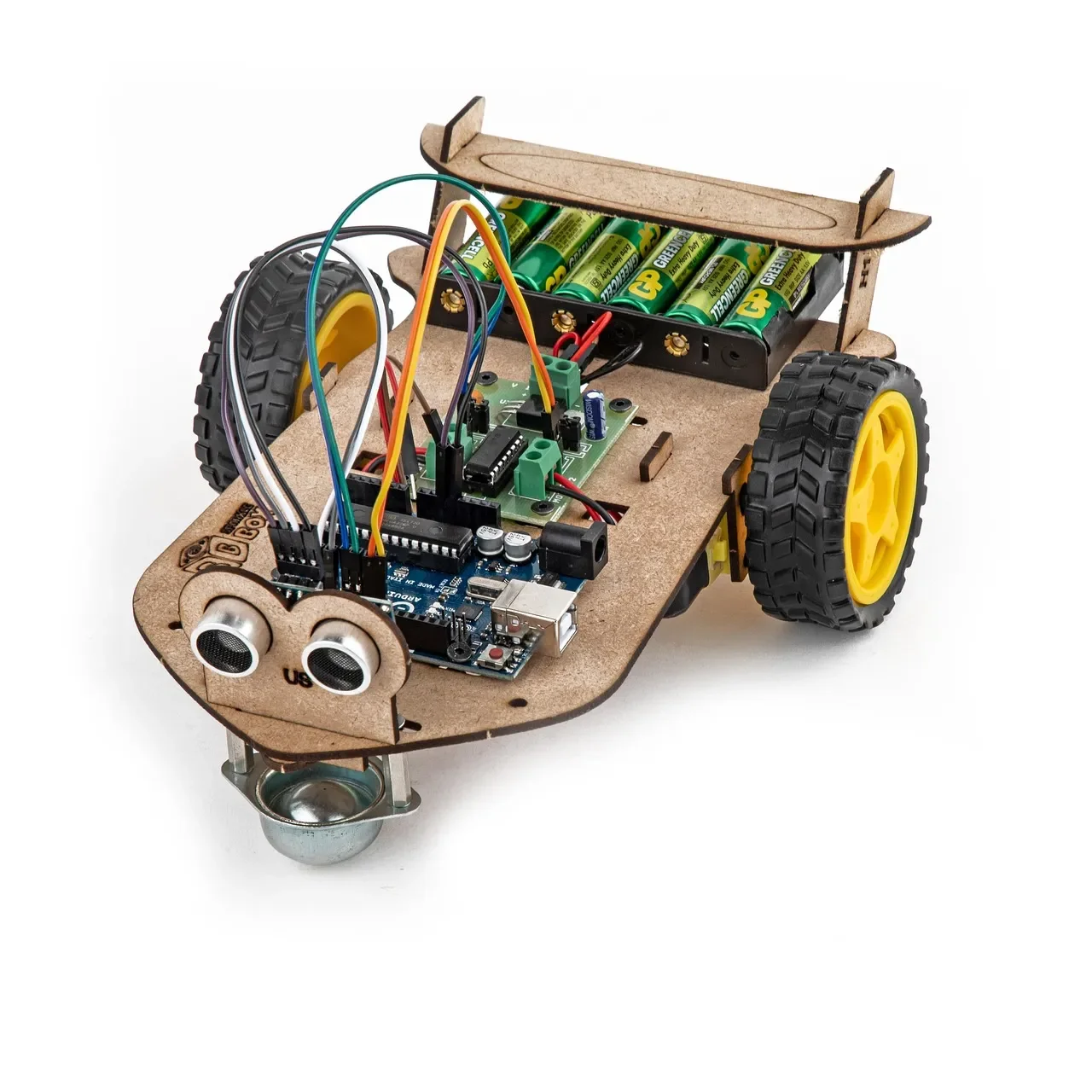
NVIDIA and Hugging Face published a detailed workflow for adding local obstacle avoidance to the Microduck quadruped robot while keeping its core walking policy fixed. The release provides a complete Sim2Real pipeline using Isaac Lab for training and Newton for physics and sensor simulation. The approach separates balance from navigation: a frozen walking policy handles joint actuation, while a newly trained navigation policy adjusts velocity commands based on time-of-flight (ToF) sensor data.
The environment builds varied obstacle courses using reusable OpenUSD assets from SimReady Central, including cardboard boxes, office bins, and bedside cabinets, mixed with primitive geometry. At each episode reset, the code samples a layout, shuffles the props, and varies their placement and rotation. The navigation policy receives ToF history, body state, and controller state at 50 Hz. During training, the critic accesses additional simulation state to guide learning, but the actor relies only on data available on the real robot. Rewards encourage progress toward goals and safe arrivals, while penalizing fast approaches, abrupt command changes, collisions, and falls.
To model the robot's VL53L5CX sensor, the team extended Newton’s LegacyMultiMeshRayCasterCamera. The simulated sensor produces an 8×8 distance grid at 15 Hz with a 45° field of view and a 0.12–4 m range. The configuration includes realistic imperfections: training injects noise, delays, and missing measurements, particularly near the grid edges, to force the policy to handle imperfect data. The sensor follows the duck’s head, matching the physical placement on the hardware.
Training runs PPO across 16,384 parallel environments for 1,500 iterations. The authors note that this environment count is configurable; they also demonstrated a smaller-scale run on an NVIDIA DGX Spark using 4,096 environments for 3,000 updates, which completed in roughly six hours. Once training finishes, the navigation checkpoint exports to TorchScript and ONNX formats. The deployment script packages the ONNX model alongside its external data file and streams sensor data to a laptop. A dry-run mode allows developers to verify proposed commands against obstacles before enabling movement. When active, the system caps forward speed at 0.15 m/s and applies a close-obstacle brake, with the operator retaining control via a gamepad.
The obstacle-avoidance task lives in isaaclab_tasks.contrib.microduck_obstacle, with configuration managed in obstacle_avoidance_env_cfg.py. The sensor randomization parameters explicitly define mount pitch variations between -10.0 and 10.0 degrees, height offsets up to 0.02 meters, and a 50% probability of near-floor edge impairment. This forces the policy to learn robust navigation despite sensor degradation.
Deployment requires setting up SSH access to the robot and verifying the walking policy export. Developers run a dry-run command using nav_pad.py, which copies helper scripts, streams sensor data, and proposes movement commands without actually moving the robot. This allows practitioners to watch how the policy reacts as obstacles enter the sensor's view. Once verified, the same script enables supervised gamepad navigation, where holding the stick forward requests movement and the policy adjusts the command to avoid obstacles. Releasing the stick stops the robot, and the system enforces a default forward speed cap of 0.15 m/s alongside a close-obstacle brake.
 Illustrative image: kuszapro / Pixabay
Coding agents develop standalone game programs
In a separate evaluation of autonomous coding systems, researchers from Tencent ARC Lab, Great Bay University, Beijing Jiaotong University, and Nanjing University introduced Coding4Games, a benchmark designed to test whether coding agents can develop standalone programs that play modern video games. The paper, published on arXiv in August 2026, argues that existing game benchmarks primarily evaluate language models as computer-use agents that query the model repeatedly during play. This approach incurs high inference costs and struggles with real-time environments where the game state evolves between inference steps.
Coding4Games shifts the focus to program development. The benchmark provides a gym-like interface that wraps 15 modern games across five categories: combat and action timing, strategy and resource planning, 3D sports and precision control, movement and timing, and multi-step task execution. Titles include Black Myth: Wukong, Sekiro, Forza Horizon 5, and Overcooked! 2. The evaluation framework strictly separates development from testing. During the development stage, a coding agent operates in a persistent sandbox, using a real coding CLI to write, execute, and debug programs. The agent interacts with the game through a host-side game server that tracks elapsed tics and enforces token and game-tic budgets. The agent can self-test and revise its code, but it cannot directly edit game files or scores.
Once the agent selects a program, the test stage begins. The chosen program freezes and runs independently in a fresh environment without any language-model inference or network access. A host-side scorer computes task-specific metrics, such as boss-health depletion or distance traveled, based on recorded gameplay evidence. This setup measures whether agents can translate interactive understanding into reliable, executable behavior that operates autonomously.
The framework enforces strict interaction budgets to bound development. Most games allocate 10,000 cumulative game tics and 20 million tokens, while titles like Sekiro allow 50 million tokens and Overcooked! 2 allows 20,000 tics. The evaluation tested 12 coding agents, revealing significant performance variance across different architectures. Closed models like GPT-6-Astra achieved perfect scores on Balatro and Forza Horizon 5 but scored 0.0 on Overcooked! 2. Open models like Qwen3.8-27B showed mixed results, scoring 58.1 on NBA 2K25 but 0.0 on Black Myth: Wukong. Despite these variations, the best program per game consistently outscored the strongest graphical user interface (GUI) baseline on 13 of 15 games.
Human players still outscored all agents on 10 of the 15 games. The results demonstrate that coding agents can successfully convert complex visual and control demands into standalone scripts, but they also expose a persistent limitation in autonomous improvement. Process analysis showed that while agents frequently identify failures during self-testing, they often fail to translate that feedback into effective strategy revisions. The gap between recognizing a problem and implementing a robust fix remains a central challenge for coding agents operating in dynamic environments.
Sources
- huggingface.co: Microduck Obstacle Avoidance: A Sim2Real Workflow with Isaac Lab and Newton
- arXiv: Coding4Games: Can Modern Coding Agents Play Modern Video Games?
PNEUMETRON EDITORIAL
Pneumetron's pipeline pairs AI-assisted drafting with human editorial review before publishing — our goal is to make staying informed easier, not to replace real reporting.