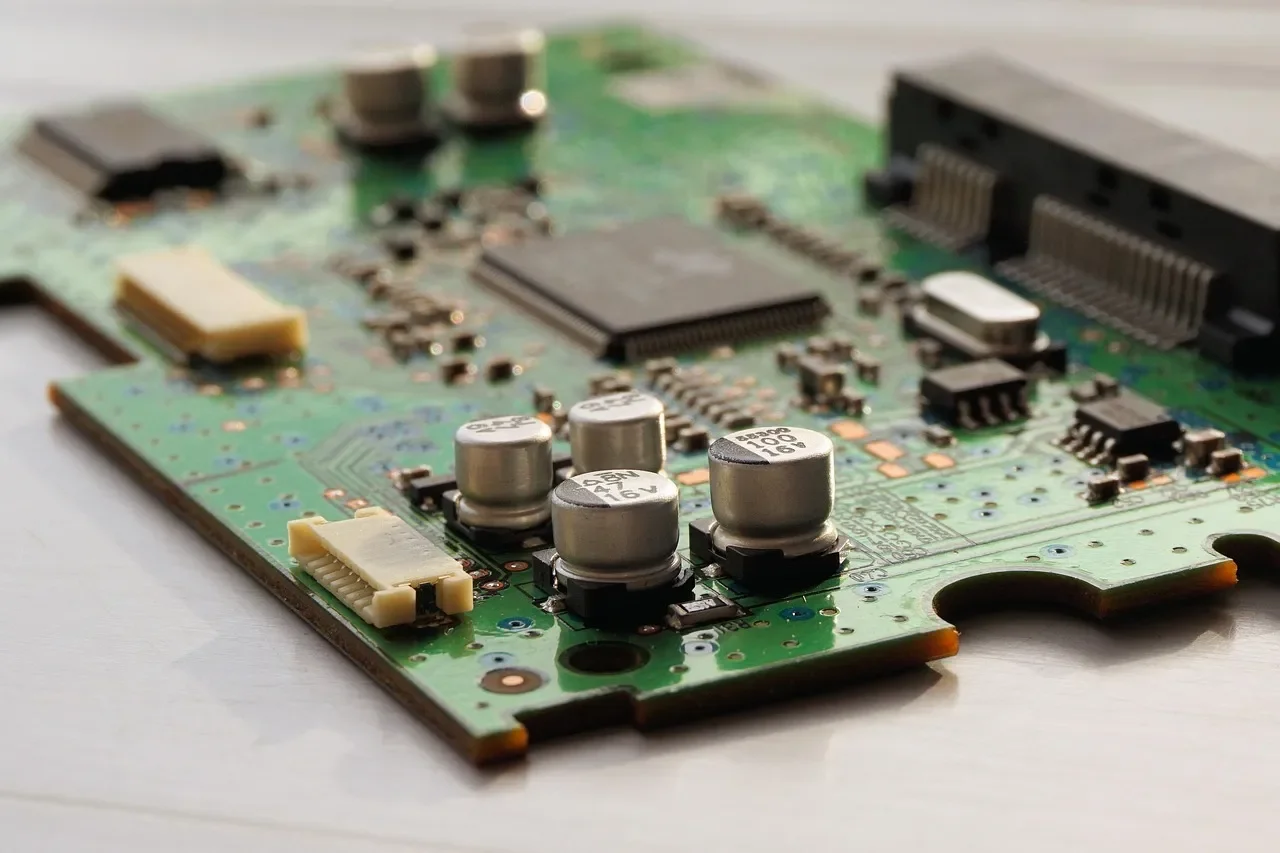
OpenAI reports production chip design gains
OpenAI says its frontier models have delivered double-digit improvements in power, performance, and area on production silicon designs. The company reports that GPT models reduced standard-cell area by roughly 13 percent in the vector unit and 10 percent in the matrix unit of its custom inference chip, Jalapeño. Those optimizations were silicon proven during bring-up. On third-party hardware, OpenAI claims up to 14 percent PPA improvement relative to heavily optimized baselines on AMD’s flagship GPU IP. The model identified gains by rewriting SystemVerilog RTL, a process the company estimates compressed a year of engineering progress into under five months. AMD has already incorporated some of these changes into a design sent for manufacturing.
To track capability progression, OpenAI tested successive model generations on two open-source 32-bit RISC-V cores: PicoRV32 and OpenTitan’s Ibex. The task required increasing throughput while keeping area within 16 times the original footprint. Each run consumed about 112,000 tokens. GPT-6.2 Astra achieved the highest average score across both cores, followed by GPT-6.1 Sol, which outperformed GPT-5.6 Sol. When given written requirements instead of existing RTL, all five tested models scored higher on throughput, likely because they could omit features like performance counters that do not improve the test workloads. The evaluation included 9,881 scored runs across both tasks, both cores, and multiple token budgets.
OpenAI notes that the models reason about RTL at the level of an expert microarchitect, rewriting circuits that perform calculations, control operations, or move data. The company used Synopsys tools to verify that each rewrite preserved block behavior and evaluated trade-offs in power, performance, and area. OpenAI is now partnering with Synopsys to train a model to use electronic design automation tools directly, aiming to ground capability development in trusted evaluators.
METR tracks capability shifts on judgment tasks
METR released an updated version of its time horizon plot, tracking how long it takes models to complete tasks that humans have already finished. The report confirms that capability on verifiable tasks continues to improve along an exponential trajectory, with the length of successfully completed tasks doubling roughly every four months. Coding and mathematics remain the strongest domains, where automatic verification allows reinforcement learning to strengthen successful pathways efficiently.
The update introduces open-ended tasks that require judgment, such as designing new AI evaluations or scoring philosophical arguments. On these tasks, models still fall short of human utility. The most advanced systems produced evaluation designs that METR staff did not consider useful for their research, and they struggled to match human consistency on philosophical scoring. One newer model, Opus 5.5, reached what METR calls borderline above the bar performance on evaluation design, a noticeable shift from a year ago when every model scored clearly below the bar. Experts note that these judgment-heavy tasks are difficult to score reliably, making it hard to extrapolate whether models will close the gap. METR researchers explicitly state that predicting progress on underspecified tasks will remain difficult compared to easily verifiable benchmarks.
 Illustrative image: QuinceCreative / Pixabay
Task difficulty in the updated plot is measured by human completion time estimates, since paying experts to complete tasks that might take hundreds of hours is prohibitively expensive. Some tasks carry specific scoring limitations; for example, the philosophical argument task relied on a single rater for most arguments, and agent scores were judged by how well they agreed with that individual. Researchers acknowledge that scores could shift if more experts were surveyed, but the logistical cost remains high. The inclusion of these fuzzier tasks marks a deliberate shift in evaluation strategy, though the data currently supports only directional observations rather than clean trend lines.
A gradient-based method filters synthetic driving data
Researchers from Tongji University and UNC Chapel Hill introduced a framework called Policy-Aware Data Valuation (PAD) to address the problem of indiscriminate synthetic data scaling in autonomous driving. The authors report that adding more demonstrations does not guarantee better policies, as redundant or misaligned samples can cause scenario-specific regressions. PAD assigns each candidate demonstration a utility score specific to the target driving policy by combining scene-level calibration feedback with projected policy gradients and a regularized approximation of local training geometry.
The framework uses influence-based estimation to rank synthetic data without retraining the policy for every candidate. In controlled experiments on DiffusionDrive, PAD improved the EPDMS metric by 3.5 points on the NavTest benchmark and 5.0 points on NavHard compared to training on real data alone. The gains held across diffusion-, regression-, and flow-matching-based planners. The authors also show that indiscriminate synthetic augmentation can push a policy into zero-score failure states, whereas PAD’s curated selection avoids those regressions while preserving useful supervision. The method restricts gradient attribution to trajectory-producing parameters during valuation but retrains the full policy with its native objective.
PAD constructs a fixed calibration set of 4,000 real scenes and evaluates the base checkpoint on each scene to compute standardized outcome weights. The framework uses a Gaussian projection with a dimension of 2,048 to approximate the local inverse training geometry, solving a single projected linear system to compute values for every candidate. The selected demonstrations are combined with the real dataset, and the complete policy is retrained using its native architecture and training recipe. The authors note that while PAD improves data composition, it cannot eliminate errors caused by unresolved policy limitations or extreme scene complexity, and it occasionally fails to satisfy strict time-to-collision criteria in highly irregular junctions. Code and project pages are publicly available.
Sources
- openai.com: Advancing chip design with OpenAI models
- arXiv: PAD: Policy-Aware Data Valuation for Autonomous Driving
- technologyreview.com: The most misunderstood graph in AI just got a major update
PNEUMETRON EDITORIAL
Pneumetron's pipeline pairs AI-assisted drafting with human editorial review before publishing — our goal is to make staying informed easier, not to replace real reporting.